Showing posts with label Politics. Show all posts

Saturday, 13 September 2008

Stupid Guides To Very Select Situations: #2- How To Beat Barack Obama In A Presidential Election


  1. Choose a female running mate.
  2. Accuse Obama of sexism.

With Sarah Palin as John McCain’s running partner, the underhand tactic employed by the Republican party to cling on to their hold of the White House was to select a vice presidential candidate based on their gender. It represents a last throw of the dice; an attempt to sway some of those undecided voters (the ones who backed Hilary Clinton) by public displaying a “21st century” style government of their own. If McCain were elected to power, and later died in office *touches wood*, then Palin would rise to the helm, and please all those pro-women voters.

I don’t question the credentials of Palin. She served the pleasing maximum two terms as mayor of Wasilla, and ran a successful campaign to become governor of Alaska. In fact, her glittering political CV suggests she is more equipped to run the US than Barack Obama is; for one, she’s run a city, and he hasn’t. She isn’t a full-blooded Republican, however, and has been known to go against her party periodically. Ironically, McCain also criticised Palin for some of her work during her time as Wasilla’s mayor.

Polls have already shown an increase in McCain’s popularity. The victor of the 2008 US presidential election is not a foregone conclusion just yet.

Tuesday, 2 September 2008

Poetry In Motion: #3- The Banana Song


One banana,
Two banana,
Three banana,

Four.

This poor slave farmer
Can no longer pick bananas,
For his hands are bloody
And raw.

One banana,
Two banana,
Three banana,
Four.

These dioramas
Do not depict the drama
Of the labour
The slaves must endure.

To the hills, they should scarper;
Though instead, they work harder,
So they can buy
The little they can afford.

Five banana,
Six banana,
Seven banana,

No more.

Monday, 18 August 2008

You Make Me So Hot, Malaysia, But I Promise Not To Be Too Arousing


Ahh, NME! You really are first for music news. Around an hour ago, it was announced that Bloc Party would be releasing their third album, entitled Intimacy, on MP3 format in 3 days time. Very short notice for a band, which had thought not long ago that the album would not be ready until next year. Here they are, providing us with a digital release 4 months before Christmas, and a CD release date penned in for October 21st.

I was ecstatic – and a wee bit miffed at the spontaneity of the declaration – about the news. However, it was whilst I was thumbing through a few other articles on NME’s website that I came across something more intriguing to the eye.

Avril Lavigne may be forced to cancel a booked concert in Malaysia if her dance moves are deemed to be “too sexy”.

Oh no, you haven't read that incorrectly. This is a significant possibility.

The whole concept is laughable. How on earth can you define “too sexy”? What is that? Sounds like something a virile young man would use in the middle of a cheesy chat-up line, standing around in a shady nightclub.

“Miss, I’m going to have to arrest you. You are too sexy!” I could never bring myself to use a thing so crass with the intention of picking a girl up in my life.

Naturally, any woman would huff whenever they heard such a thing; knowing full well it was a lame attempt to get into her underwear. Sadly for Avril Lavigne, she must take the comment 100% seriously, and know for once that the purpose is certainly not to do with anyone making sexual advances towards her. How can you listen to that comment without letting out a laugh of disbelief at the very least?

Apparently, according to the article, it isn’t the first time western female artists have run into difficulties trying to organise shows in Malaysia, a largely Muslim country. Conduct on stage is laid out by a set of strict guidelines: no visible skin between the chest and knees, no jumping or shouting, and minimal sexual contact on stage (no kissing or hugging or any sort). They absolutely must be abided by. Therein lies the confusion over the comment; if Avril Lavigne were to adhere to all of these rules, why should her show need to be scrapped?

I can understand some of the calls against Avril Lavigne’s traditional style; if they feel it wouldn’t be appropriate for people of their religion to see it, fine, they have basis for saying it shouldn’t be allowed to be shown then. But Lavigne must already know about the stringent policies in place, as her tour opens at the end of this month. What I am beset with anger about is the fact that the party (a youth wing at that) who wants to see the cancellation of the concert have made up an incongruous reason for it, and do not appear willing to compromise. They say that they don’t want their teenagers seeing it, as her performance could influence them? Excuse me? Teenagers aren’t all 5 years old! They don’t follow everything they see. The ones that do are a gigantic minority, since most teenagers can think and act for themselves. And anyway, why not let them make the decision whether they should be going to show or not? Most Muslims would surely decide not to attend if they thought it would be offensive to their faith once forewarned, right? They could at least seek some public opinion, because it clearly wouldn’t be fair to the fans. In reality, that wouldn’t have made any difference. If the public opinion polls don’t agree with what you want to do, you just ignore them. It happens over here in the UK too, and is nothing new. Why bother calling it a democracy when people are told what to think, eh?

Can’t Lavigne be asked to cut out the moves that are “too sexy” out of her routine? Was that suggested?

The Malaysian government has yet to decide whether or not to allow Lavigne to perform. Let’s hope they permit it.

A little bit extra:

Read the article in full
...
http://www.nme.com/news/avril-lavigne/39032

Friday, 15 August 2008

Intruders


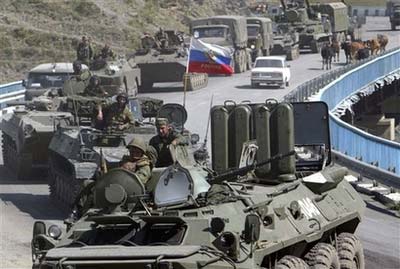
The name “South Ossetia” would have been seldom quoted outside of Georgia and Russia before August. In all likelihood, scant people would be able to recognise the name, let alone disclose information to others upon its whereabouts and current political state of affairs.

It must’ve been a bitterly cold day in November when I first happened upon details pertaining to what is the de facto independent nation of South Ossetia. It is located in the north region of Georgia, and forms part of the border between the internationally recognised boundary of Georgia and Russia. The section defined as being South Ossetia is 3,900km², equating out to roughly 5.6% of Georgia’s confirmed territory. To put that into perspective, South Ossetia is precious little more than 1/100th of the size of the UK, and is just under 2½ times bigger than Greater London alone.

The troubled disputes in South Ossetia have been ongoing effectively from before Georgia even announced its independence from the old Soviet Union. South Ossetia first declared its independence from Georgia in 1990, with an overall goal of unifying itself with North Ossetia (currently considered part of Russian territory) to form an individual nation for Ossetians. The Georgian Supreme Council took offense to this, declaring any such announcements illegal, and therefore void. The bitter hostility between the two sides from that moment on only depreciated right up until the first South Ossetian war in 1991. Here, it was the Georgians who triggered the alarm by marching into South Ossetia’s capital city, Tskhinvali. Naturally, South Ossetia, soon bolstered by a number of volunteer recruits from North Ossetia, rebelled, ensuring that bloodshed ensued around 3,000 people were killed.

What is always important to remember is that South Ossetia operates completely separately from Georgia. What we see on an ordinary map as the country of Georgia is never going to tell us the full story. South Ossetia isn’t even the SOLE separatist region within Georgia: a region in the north-west quadrant known as Abkhazia (also mentioned is a small number of news reports), functions in a similar vein to South Ossetia, and in addition, it too longs for independence.

The main difference between this existing war over South Ossetia and the one that occurred during nearly the entire calendar year of 1991, and over half of 1992 is the involvement of Russia. Last time around, Russian military took a very lax approach to the violence; surfacing intermittently. In the end, a ceasefire was negotiated with the HELP of the Russians. The Russians now have a vested interest this time to block any attempts of Georgia regaining control of the area, as many South Ossetians are in possession of Russian passports. Georgia accuses Russia of attempting to annex South Ossetia.

If you look at this example of an escalating argument over land, other cases are present nearby. Abkhazia, as I mentioned earlier, has also been a de facto independent nation since the 1990s. Nagorno-Karabakh, which is enclosed by Azerbaijan, called for secession in late 1991, and Transnitria – making up around 50% of the border between Moldova and Ukraine – announced its separation from Moldova over a year prior to that. Moreover, the horrors of Chechnya and Kosovo have been in the news on frequents bases (Kosovo, as of 2008, is now a partially recognised country). Do you notice a pattern? Apart from Kosovo – it being part of collapsed Yugoslavia, where unrest has not died down – all of these regions are located within the boundaries of the Soviet Union, meaning even now, nearly 17 years on from the end of the Cold War, conflict thrives. And worse is that none of them have attained universal country status recognition. In fact, all but Kosovo are not seen as countries by any nations of the world, signifying a product where the world audience is left largely ignorant to the struggles necessitated when these people pursue true freedom.

A ceasefire was said to have been implemented a few days ago. But further pandemonium has since erupted.

Friday, 25 July 2008

No More Brown Sound


The date: 25th July 2008. A date that may stick long in the memory banks of a certain prime minister as the day he realised the damages to his government were irreparable. Is this finally the beginning of the end for Gordon Brown?

Today, the SNP pulled off one of the biggest shocks in by-election history by de-seating the Labour candidate, Margaret Curran, from her throne in Glasgow East. Prior to the election, it was this seat that had been considered one of the safest Labour-held seats in the UK. This is certainly no longer the case.

Usually, whenever there is an election, a swing of maybe 2-3% wouldn’t be considered as being out of ordinary. Any swing from 5% upwards, and we begin to enter the realms of drastic changes. The 22.54% swing seen today to launch Labour’s on-going plight into further chaos, was astounding, and quite frankly, could not have been presaged. No matter how poorly Gordon Brown has been handling the important issues that are crippling our economy and society, such a huge shift in voting patterns was never to be expected; the change was so shocking, a few suggested that this was a protest vote against Labour, not a supportive vote for the Scottish National Party.

Statistics were carried out, and in summary, all but 5 of Brown’s cabinet would have been axed from their seats with a swing that great. The casualties would have included big names such as Ed Balls (Secretary of State for Children, Schools and Families), Alistair Darling (Chancellor of the Exchequer), David Miliband (Secretary of State for Foreign and Commonwealth Affairs), and Jacqui Smith (Home Secretary).

What has transpired cannot be ignored; this is no longer the time to shrug off a defeat and promise to “bounce back” stronger than ever. The calls for a general election need to be heeded. And they need to be heeded soon.

If our country is going to progress any further (i.e. fight off the possibility of a recession, which is said to be less of a threat now than it was a weak ago), we need big changes at the top. Traditionally, I would never support backing the Tories. But right now, even though I’m worried the job they’ll accomplish won’t be much better than what Gordon Brown has done so far, there will be a level of improvement.

I never disagreed with Tony Blair as our PM. I personally thought he was the best PM we’d had in years. The only major furore he caused was over his foreign policies, namely Iraq and Afghanistan. Scratch that from the equation, and he was practically a model prime minister. It’s all too clear that we’ve put ourselves at the wrong end of a “If it ain’t broke, don’t fix it” situation. Fine, we didn’t elect Gordon Brown to succeed Blair, but we put so much pressure on the latter that he only had choice, and that was to step down. I would choose to have him back at the helm than David Cameron any day.

The sun is setting on Brown’s time in 10 Downing Street. The question is who will be the next to move in?

Thursday, 17 July 2008

Beijing Duck


The 29th hosting of the Summer Olympics takes place later this year in Beijing. And not too much later at that; the opening ceremony occurs in just 22 days. China stakes a claim to fame at present by representing the world’s fastest growing national economy – despite there still being widespread, remote areas within mainland China that do not see any of this additional money (those living in the largest, and best-known areas of the country take precedence over everyone else, i.e. the citizens of Shanghai, Beijing, etc).

We all have a vague idea of the discord shrouding these Olympics; the most notable antipathy to it stemming from the pro-Tibetan community, and their outrage towards the Chinese for, amongst other things, what they see in their eyes as a hypocritical stance on the government’s behalf to host the Olympics, since numerous reports pour out of China faster than water out of a kettle, stating the country defies a number of human rights laws. The human rights violations are in direct offence of what the Olympics are supposed to stand for: equality. These pro-Tibetan groups have also threatened to boycott the Games in order to pressurise the government further into giving Tibet its independence. Other safety risks concerning the Games include the danger imposed by potential terrorist attacks – with this risk heightened once Chinese police had uncovered a plot revolving around suicide bombers and kidnappings – and increased levels of damage to the environment by air pollution, since China did not have a stringent policy to clamp down on heavy pollution in place until fairly recently – made all the more apparent when in 2006, it was announced that China had surpassed the US in its rate of carbon dioxide emissions.

The Beijing National stadium, affectionately dubbed the “Bird’s Nest” for quite unambiguous reasons (if you must have it spelled out, it is so called due to its architectural structure), will host all track & field events in the Athletics discipline, and will too be the site of the opening and closing ceremonies.

There hasn’t been a great deal of media hype around the tournament itself. Mainly, it’s revolved around the issues suitably placed at China’s front door mat; a door mat that has been ineffectually swept clean by a dismissive government. Ergo, the focus placed upon the athletes about to take part in it has been nigh on absent in its entirety. The lack of adequate media attention is down to a need for the Games to start in a “hush-hush” mood, as not to provoke more scathing attacks from pro-Tibetan organisations or Amnesty International.

Nonetheless, adverse to the controversy, Beijing 2008 promises to be one of the most fiercely-competed yet. Nations like the United States are planning to bring their largest Olympic team thus far, and nine new events are to be participated in for the first time. There could be athletes contested medals from as many as 205 countries and dependent territories around the world.

If it runs smoothly, these Olympics could be the greatest ever. With that mind in it, it is vital to observe that “if” with warning. Should something major disrupt scheduling, that success may change to a catastrophe, worse than the respective American-led and Soviet-led boycotts of the 1980 and 1984 Olympic Games. The consensus is for the tournament to progress unimpeded.

Bear in mind that when they’re finished, London 2012 is next up on the Olympic timetable…

Monday, 14 July 2008

Knife And Farce


Minutes ago, I decided to turn on the television. As any human being would ordinarily do when not compelled to view anything in particular, I began skimming through the channels at a canter, in order to find some remotely decent programming for possibly an hour or two. And do you know what befell my eyes? Yet another report relating to knife crime in the UK (particularly connected to London, as once again, this recent spate of well-publicised stabbings has been centralised around our nation’s capital). But there was something different about this report that sparked my attention instantaneously. Shall I proceed to tell you what this was? Very well.

It seems that the government believes it to be a “good idea” to force the perpetrators of knife crime into visiting their victims in whichever second-rate hospital they’ve been sent to get patched up. Whether I misheard what the journalist said – causing the specifics of the entire notion to be lost in a sea of anger and indignation at the idea in hand – is beyond me, and altogether possible. In fact, if the above is true, I see no reason to justify, in any circumstance, the passing-through of such a law. What would it entail? The soon-to-be convicts choosing to finish the job they set out to do, whilst the victim is helpless to prevent a further attack? I’m sorry, call me sceptical and all that, but I don’t really think giving the persons responsible for the injuries they have already inflicted a second bite at the cherry is going to solve the problem with deaths from knife-related incidents.

One thing is certain, however. I can best describe the government’s proposal to deter these people from carrying out violent attacks in a simple word: lunacy.

Is it so easy to forget that a lot of those liable are proud of their work? Heck, sending them to see victims is an extra chance to take a picture of their handiwork on their stolen camera phones. Or, at the very least, it gives them a plethora of new ideas on how to cut/slash/shank someone the next time they choose to do it. Apparently, according to some, stabbing someone can be seen as a work of art. Their prey is the canvas, their knife is the paintbrush.

The government’s wording is that “people caught carrying knives are to be sent to visit stabbing victims in hospital to show them the potential consequences”. I’m pretty sure any person who’s carrying a knife around with them knows what the consequences are when they use it. They are willingly carrying around weapons; weapons that are dematerialising the fabric that acts a security blanket of our society. Sooner or later, they are going to act with it, and by that point, it doesn’t matter why they’ve used it.

A Glaswegian male was stabbed 11 times at the T in the park music festival, on Sunday morning. Fortunately, he survived, and is now recovering in hospital. Why was this man stabbed? Because he chose to help out his female friend, who had been accosted by two male strangers. Did this man get much press attention? No. He’s still alive. But I digress. Perhaps we should first look at the underlying explanation for why so many people are keeping knives on their person. It can’t all be for “self-defence”.

In all, do you honestly believe the government’s “tough” new regime is going to work wonders?